
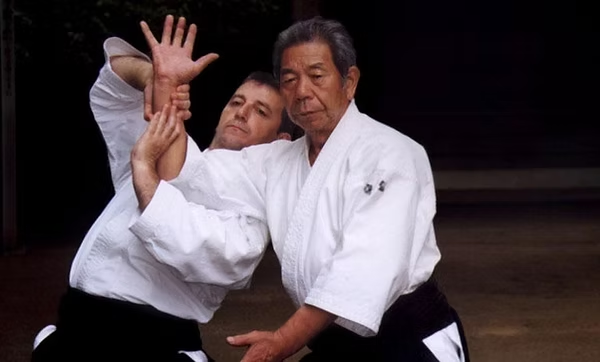
Morihiro Saito: The Guardian of the Iwama Tradition
Morihiro Saito Sensei (1928–2002) occupies a unique and vital position in the history of Aikido. For twenty-three years, he lived and trained as a devoted student of Morihei Ueshiba, the Founder of Aikido. From the age of 18 until the Founder’s passing in 1969, Saito Sensei received a specialized education that was unprecedented among the Founder’s disciples.
The Technical Heir of Aiki
Saito Sensei was widely regarded as the technical heir to Master Ueshiba, particularly concerning the weapons of Aikido: the Aikiken (sword) and Aikijo (staff). While the Founder often demonstrated these weapons in public, he rarely taught them in detail outside of his personal Dojo in Iwama.
Because Saito Sensei was present daily in Iwama, he became the only student to receive the complete, codified system of weapons training directly from the Founder. This integrated relationship between open-hand techniques (Taijutsu) and weapons remains a cornerstone of the Wanomichi method.
Keeper of the Source
Following the Founder’s death in April 1969, Saito Sensei was appointed as the head of the Iwama Dojo and the guardian of the Aiki Jinja, the sacred temple dedicated to the art. For over thirty years, he preserved the Founder’s teachings exactly as he had received them, welcoming practitioners from across the globe as uchideshi (live-in students) to train “at the source.”
A Legacy of Teaching
Saito Sensei was one of the world’s highest-ranking masters, holding the 9th Dan from the Aikikai Foundation in Tokyo. He was a prolific teacher and author, most notably of the six-volume series “Takemusu Aiki”, co-written with Stanley Pranin. This work is considered the definitive technical encyclopedia of the Iwama tradition.
Notably, the French translation of “Takemusu Aiki” was meticulously prepared by Daniel Toutain, further cementing the deep connection between Saito Sensei’s legacy and our school.
“The techniques of Iwama are not simply a style; they are the faithful preservation of the Founder’s life’s work.”