Technical Program: The Path of Continuous Improvement
The Wanomichi curriculum is a comprehensive system designed to lead the practitioner from foundational mechanics to creative mastery. All instructors follow this standardized program, ensuring a consistent and high-quality transmission of the art.
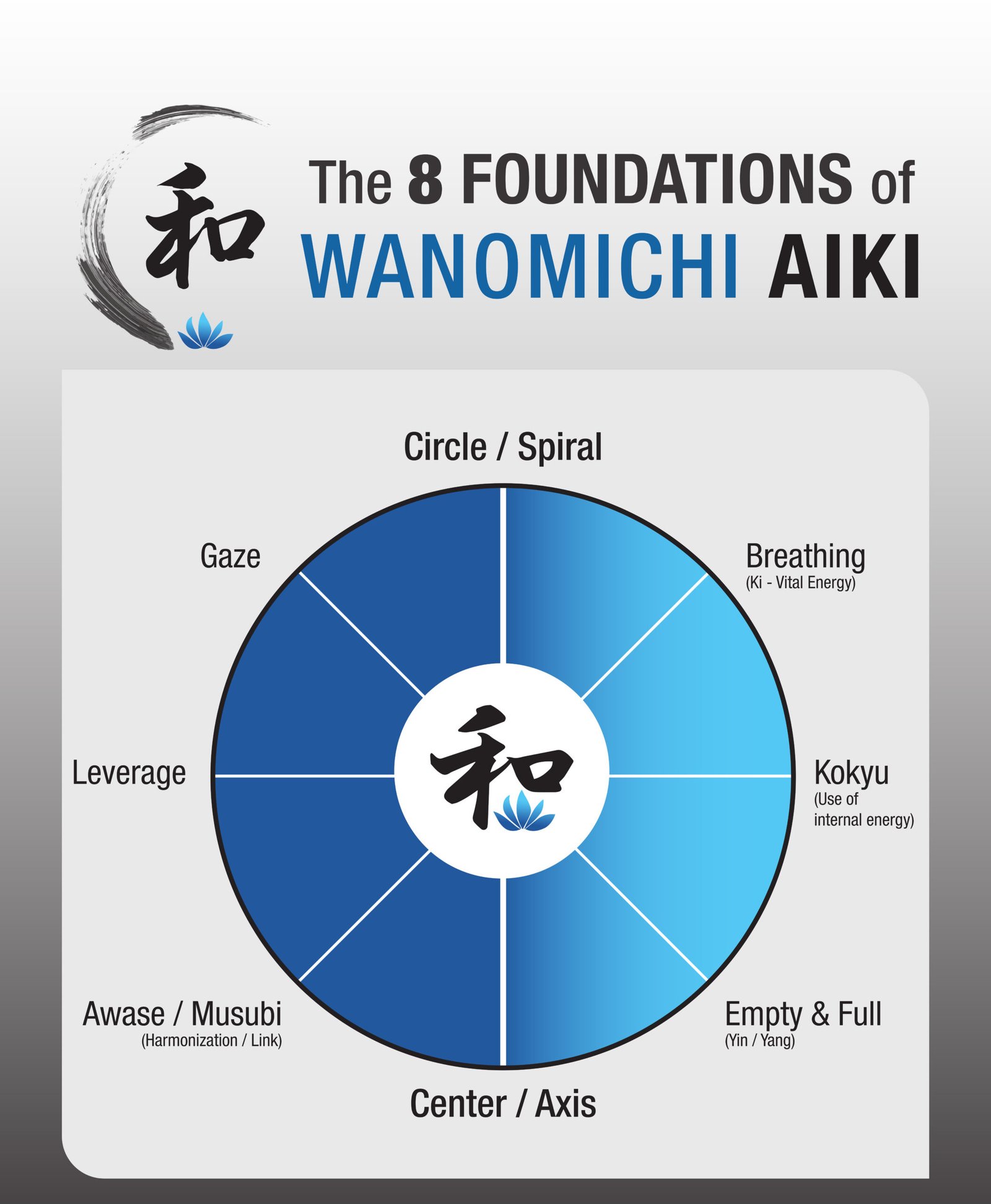
The 8 Foundations of Wanomichi Aiki
At the heart of every movement in our school lie the 8 Foundations. These principles are the “internal engine” of our techniques and are studied at every level of practice:
- Circle / Spiral: Utilizing circular and helical movements to redirect energy.
- Breathing (Ki): Developing vital energy through controlled breath.
- Kokyu: The application of internal power and timing.
- Empty & Full (Yin/Yang): Managing the balance of weight and intention.
- Center / Axis: Maintaining one’s own verticality while controlling the partner’s axis.
- Awase / Musubi: The art of harmonizing and linking with the partner’s movement.
- Leverage: Using biomechanical advantage instead of muscle strength.
- Gaze: Directing focus and awareness to control the space.
1. Kaizen Dosa (Continuous Improvement)
The term Kaizen (from Japanese kai – change, and zen – better) signifies our commitment to constant refinement. This preparatory stage is essential for integrating the 8 Foundations.
- Shinshin no Junbi: A specialized physical and mental preparation derived from Ashtanga and Gokul Yoga. It strengthens the core, increases flexibility, and synchronizes movement with breath.
- Enshin no Kata: A signature kata (sequence) that serves as the “heart of the circle,” allowing practitioners to internalize centering and spatial awareness.
- Iwama Suburi: Fundamental solo exercises with the wooden sword (Aikiken) and staff (Aikijo).
- Antagonistic Modules: Partner exercises using both bare hands and the Jo (staff) to study the axes and levers specific to Iwama techniques.
2. Taijutsu (Open-Hand Techniques)
Our empty-hand program is based on the rigorous standards of Iwama Taijutsu. The progression follows three stages:
- Kihon: In-depth study of basic techniques to understand structural principles.
- Ki no Nagare: Transitioning into fluid, dynamic forms.
- Kaeshi Waza: Advanced technique reversals, representing the highest level of harmonization and spontaneity.
3. Bukiwaza & Bukidori (Weapons)
This program preserves the authentic Aikiken, Aikijo, and Bukidori (weapon-taking) techniques of Iwama. We treat the relationship between bare-hand techniques and weapons as inseparable, with complementary additions that ensure the program remains a complete martial system.
The Evolution of the Practitioner
Training in Wanomichi is a journey through three major stages of development:
- Kihon (Foundation): Building the “body of the art” through precision.
- Ki no Nagare (Flow): Developing the ability to move without interruption.
- Takemusu (Creativity): The ultimate stage where principles are applied freely and creatively in any situation.
Wanomichi is accessible to all—men, women, and children—teaching not only technical skill but also the core values of respect, health, and mutual growth.